CBT News: How image compliance can reshape dealership valuations
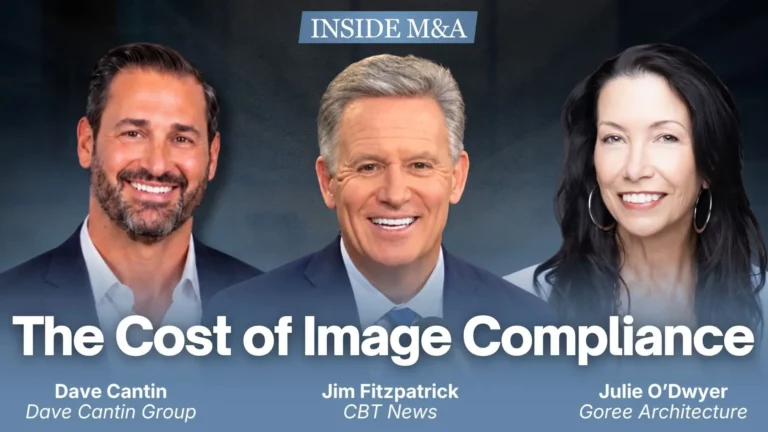
Image compliance is now included in a dealership’s purchase price. On CBT News’ Inside M&A, Dave Cantin, Founder, CEO, and Chairman of Dave Cantin Group, and Julie O’Dwyer, Director of Client and OEM Relations at Goree Architects, joined Jim Fitzpatrick to discuss how facility standards affect valuations, seller decisions, and the cost of a compliant store.
Image compliance is part of the purchase price
Buy-sell volume is what has pushed it to the front of the deal. “Front and center of all of that activity is image compliance,” Cantin said. “Now more than ever, a dealer has to evaluate the cost of bringing all of their dealerships to an image-compliant capacity.”
O’Dwyer described image compliance as the automaker’s standard for how a store should look, feel, and function, from signage and furniture to the showroom and service department. Brands typically refresh that standard every seven to 10 years. The project can be a simple update or a new building. It is often tied to a transfer of ownership, paired with OEM incentives such as cash or vehicle allotments, and it factors into future open points.
In many states, a dealer already operating a store cannot be forced to comply. Cantin said manufacturers do not set those requirements aside once a store is changing hands.
Facility cost belongs in the first review
Cantin said buyers often leave image work out of the early look at an acquisition. That is the number DCG raises first, with Goree estimating what a new owner would spend to bring the store current.
“During a buy-sell is when it really all comes down to, are you buying five stores or 10 stores? Is it a $3 million investment? Is it a $35 million investment?” Cantin said.
O’Dwyer put contractor estimates for new construction at $250 to $600 per square foot. For a 40,000-square-foot dealership, that is $10 million to $24 million. A remodel is harder to price, and a refresh can cost more than a new build when the existing structure needs systems or structural upgrades. Manufacturers may offset part of the spend with a per-car incentive or extra allotment.
She also said the letter of intent should reflect how long a rebrand or new build takes, so the buyer is not left racing a deadline after close. From there, DCG models how incentives and additional vehicles affect the return.
Brand programs are not interchangeable
Genesis wants a dedicated building, separate from Hyundai. Porsche may require a sales threshold before it approves a new facility. Nissan uses a tiered program that can stop at signage or run through the interior and exterior. Toyota’s future-facilities approach can flex with the market, the dealer, and how the store operates. Honda has pushed open showrooms, where a sale may happen on a sofa instead of at a desk.
“It’s not building the shiny new box,” Cantin said. “There are many programs that are tailored for that dealer in that community.”
Local limits can narrow the options further. In a historic district, a dealer may not be permitted to change the facade.
A re-image can be the reason to sell
Cantin said owners facing a large re-image bill, in one example, 27 stores over five years, are treating that investment as a reason to leave. The question gets sharper when the brand is no longer as profitable as it was.
“If you have a dealership that maybe isn’t as profitable as it used to be, and you have a multi-million-dollar investment that needs to be done, you’re going to second-guess it,” Cantin said. “We’re having those conversations today more than we ever have.”
Some of those owners are leaving the industry. Others are selling a single point rather than funding the project.
The payoff is a long-term asset
Asked whether a nicer store sells more cars, Cantin said yes, over time. A current facility is more inviting, and each image cycle is a bet on the customer experience, from the first visit through service.
“We don’t look at dealerships just as brick-and-mortar buildings,” Cantin said. “They are a dealership asset.”
O’Dwyer said the return also shows up with employees, who are more likely to stay in a newer facility, and on CSI and SSI surveys, where customers comment that a fresher environment felt better.
Porsche is the clearest example of a hold, not a flip. Cantin called it a blue-chip asset, noting there are fewer than 300 new-car Porsche dealerships in the U.S. Buyers still want the franchise even when the building is expensive. “Nobody’s buying a Porsche dealership saying, I’m going to buy it and flip it in three years,” he said.
Five years out, O’Dwyer expects dealerships to diverge rather than look more alike. Some brands will stay highly curated. Others will leave more room for the dealer’s personality. Cantin said the stores that work will create a wow factor at the curb and keep it until the customer leaves, sometimes with a cafe, a restaurant, or another reason not to walk out mid-transaction.
His advice to owners: start before the program is underway. Know the franchise laws in your state, talk with the local dealer association, and work with advisors who can fit the OEM requirements to the operation, the timeline, and the budget. These cycles come around every seven to 10 years. The goal is to take every incentive and allotment the manufacturer is offering.
About Dave Cantin Group
Dave Cantin Group is a leading automotive M&A advisory firm specializing in acquisitions, divestitures, platform management, business evaluations, and other corporate development services. The new retail reality requires automotive dealers to seek DCG’s collective best thinking, deep experience and extensive industry relationships to effectively leverage M&A as a core business strategy.
Clients choose DCG because we are a trusted advisor focusing on long-term relationships, investing in data and research, and engaging our entire team on every client project. Clients benefit from our industry-leading market intelligence – our Market Outlook Report – and JumpIQ, our proprietary AI-enabled platform delivering unprecedented visibility into automotive retail.
Our nonprofit initiative, DCG Giving, funds child and adolescent cancer research and treatment across the United States and supports other charitable causes important to the automotive retail community. To learn more, visit davecantingroup.com.