
The Game-Changing Evolution of Dealership Valuation
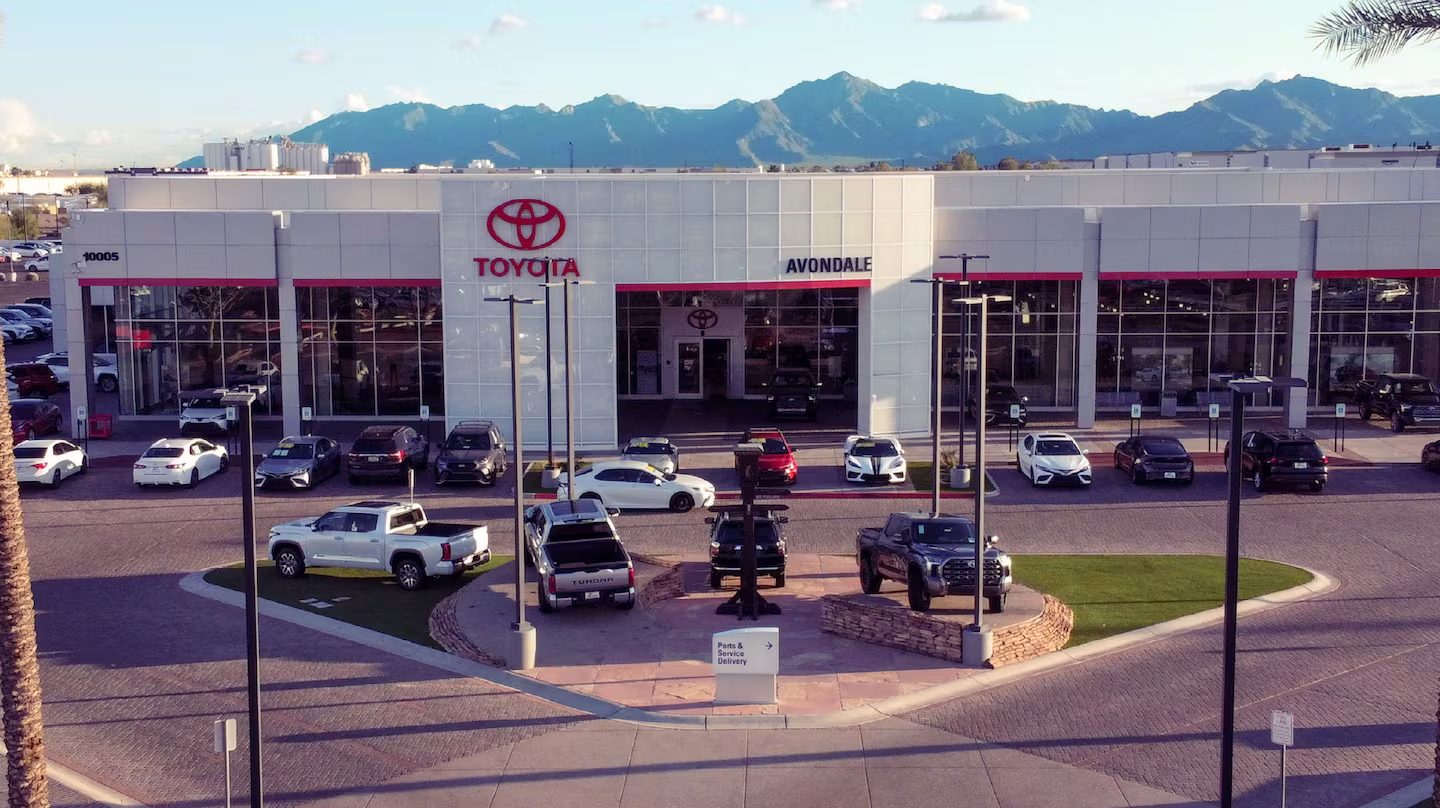
Arizona Toyota dealer Brian McCafferty says, “There’s been some real evolution” in how dealerships are valued – today, it’s more than mere multiples.
Download: DCG Evolution of Dealership Valuation Report
Dealership valuations are evolving fast as sophisticated buyers focus on future earnings and long-term potential. Here’s what’s driving the shift.
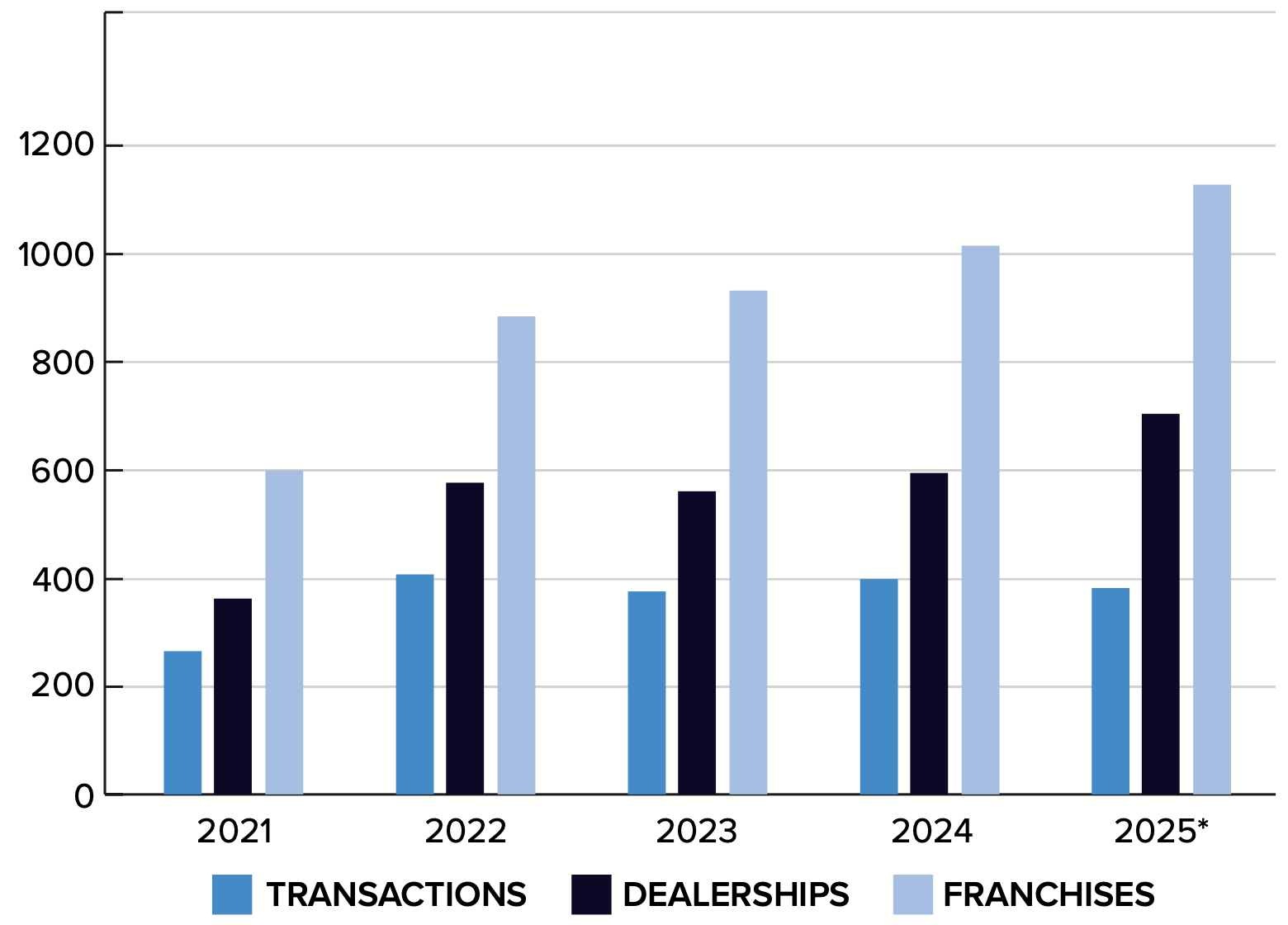
Every year, hundreds of auto dealerships are bought and sold. From 2021 through 2024, Automotive News tracked 1,575 buy-sell deals in the U.S. Despite a slow start, in 2025 the industry is on track for more than 300 transactions, representing more than 500 dealerships and 700 individual franchises.
In each one of those transactions, a seller and a buyer must ultimately agree on the value of the dealership that’s changing hands. And the smart money is increasingly on an approach that goes beyond a simple earnings-and-brand-multiple formula.
“In any dealership valuation, it always used to be: What does the dealership make? Let’s assign a multiple to that and go from there,” said Brian McCafferty, owner of three Toyota franchises, including his flagship Avondale Toyota in Arizona. “I think there’s been some real evolution in these valuations.”
The Dave Cantin Group (DCG), one of the industry’s leading M&A advisory companies, believes that as the automotive M&A marketplace has matured and become more process-driven, so has the valuation approach.
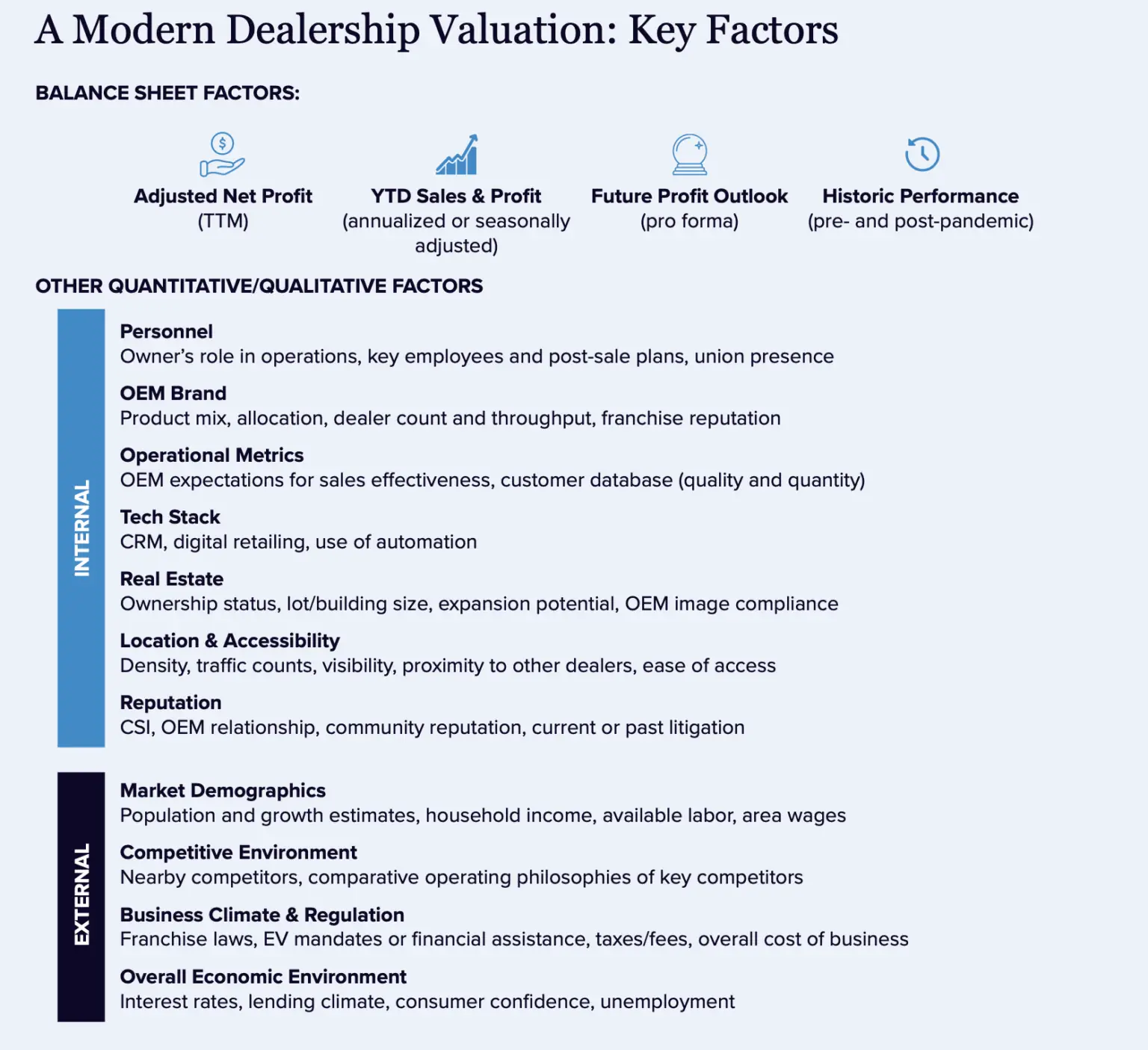
According to DCG, a modern approach to a valuation begins with the income statement, and particularly the dealership’s adjusted net profit for the past 12 months—then, importantly, looks forward by modeling future performance. Then, importantly, a smart valuation also assesses and encompasses a host of other qualitative and quantitative factors, both within the dealership and external, said Brian Traugott, a DCG partner and chief of staff. That can range from a dealership’s reputation and its employees to the local market demographics and competition.
A Changing M&A Equation
Ask what a dealership is worth, and a decade ago, most industry insiders would use a common formula: Take the dealership’s average adjusted earnings for the past three years, multiplied by a manufacturer-brand value multiple. Industry M&A experts point to several reasons why that formula is outdated.
First is the growing sophistication among today’s likeliest buyers, particularly the country’s largest dealership groups—financially advanced organizations that are acquiring stores based on strategic fit and long-term value proposition. “There has been an overall shift in the industry’s mindset, to viewing dealerships as long-term assets rather than just yearly profit-and-loss statements,” Traugott said.
“There was a time when only a few buyers were saying, ‘We have our own model and criteria to evaluate this,’” Traugott said. “Whereas today, every evaluation DCG completes with our buy-side clients, we are viewing the potential areas of opportunities and modeling their effects using DCG and the client’s tracked benchmarks. The same goes for when we are exclusively representing stores for sale, and we’re projecting future asset value for the market. This pro forma model view of potential future earnings is helping align on as much of the dealership’s value as the part performance.”
“The same goes for when we are exclusively representing stores for sale; it is much more commonplace today to hear from the buyers: ‘we know how our X-Y-Z-brand stores perform and what our expense structure looks like. I want to put this store into our group’s model and see what we think we can make with it.’ That pro forma modeling and looking at potential future earnings is helping drive as much of the dealership’s value as the past performance.”
“There has been an overall shift in the industry’s mindset, to viewing dealerships as long-term assets rather than just yearly profit-and-loss statements.” – Brian Traugott, Dave Cantin Group
Key Steps to Maximizing Dealership Value
NORMALIZE FINANCIALS
- Normalize financials quarterly, not just annually. If possible, contract with an external accounting professional to review the dealership’s financials and the financials of any related entities.
STREAMLINE OPERATIONS
- Work to streamline both the financial and operations sides of the business. Relying on outdated habits because “this is the way we have always done it” often leads to inefficient processes and increased expenses.
DOCUMENT STRATEGICALLY
- Begin to document discretionary expenses and dealer-specific items — with the spending rationale — as they occur.
- Highlight potential areas of growth or improvement for a future buyer. That might include underutilized F&I opportunities, poor used-inventory policies, leveraging expenses or sales effectiveness.
PREPARE PERSONNEL INFORMATION
- Update the organizational chart(s). Assemble comprehensive biographies for key operating personnel, along with career development plans.
INVEST IN CLEAN BACK-OFFICE SYSTEMS
- Clean back-office systems will make a buyer’s diligence process easier and faster — but also allow employees to be more efficient on a day-to-day basis.
Looking forward rather than back has become especially important in the past few years. “The valuation space has changed dramatically, and the thing that’s really changed it obviously is the pandemic,” said Steven Dougherty, senior director of business development for the Ken Garff Automotive Group, the country’s ninth-largest dealership group. “The earnings of dealerships really went through the roof during that time period. That changed how you have to approach acquisitions in this space going forward. Before that, a lot of people would look at a historical three-year P&L and see what the business was doing and have more or less confidence that that baseline would continue. But now, looking back a couple of years, you see this giant roller coaster. I think it’s safe to say that we may never see those types of earnings in the industry ever again. So we’ve been trying to figure out where we are going to level off and stabilize post-pandemic.”
The approach to valuation is also changing simply because there’s so much more conversation about buying and selling dealerships. It’s made everyone more conscious about valuations. “M&A is now a main topic of conversation in the industry, not just among dealers but also manufacturers,” said Traugott. “M&A is now built into the fabric of how the industry reshapes itself over time, how dealers grow or divest of platforms to meet their strategies, how new dealers get into the business and how manufacturers evolve with their business partners. Valuations have also become a measuring stick for manufacturers; how their dealerships are viewed in the market is directly correlated to the strength of their brand value.”
And finally, there is also a realization that at least part of a valuation is subjective, based on the individual potential buyer. “With any dealership, there are no two people who are going to value the store in the same way. It will be worth something different to each potential buyer,” Traugott said. “For some people, certain synergies mean that a dealership just makes more financial sense than others. Sometimes it is hard to put a number on that.”
“In short, there are a lot of aspects that come into play when creating a valuation to match the sophistication of today’s buyers.”
The Nuances of a Modern Valuation
What this means is that valuations are more complex and also variable. “When working with sophisticated buyers, we consider many factors in valuation,” said Traugott. That includes the basic financial benchmarks — especially adjusted net profit for the past 12 months — but also takes into account everything from the OEM brand value to regional market forecasts, recent comparable transactions and future performance potential.
McCafferty, who sold his 4-year-old Subaru store in late 2025 with DCG as his adviser, believed it was critical that interested buyers not just consider his dealership’s initial four years of sales but also its future potential. “What’s the runway of these earnings?” he said. “With only four years, we don’t really have a mature store. What’s the potential for this dealership?”
Traugott emphasizes that no two dealerships are the same, even in the same brand family, and shouldn’t be valued the same. “The multiple isn’t fixed across regions, brands or dealer groups,” he said. “The real driver of value is the aggregation of all the factors that can help assess the business’s future potential to perform over time.”
For Garff, which has acquired 24 rooftops in the past five years, the method of valuing a prospective purchase is multilayered — and specific to the company. In addition to the historical three-year P&L statement, Garff uses its own pro forma modeling to project a store’s earnings. It compares dealerships to stores from the same OEM in its portfolio.
Dougherty listed some of the top factors in Garff’s valuations:
- Geographic region and specific location. “We want to feel really confident about the area that we’re going to operate in — that there’s good population growth and good compensation growth,” he said.
- Local competition: where the dealers are located, what their reputations are, and how long they’ve been in business.
- Sales volume on new and used cars and per-vehicle retail profit.
- Service volume.
- Perceived future capital expenditures, including assessing the condition of the facility, expected remodels, or OEM facility requirements.
“A lot of what we spend our time doing is asking where we want to be, where we want to grow and have a presence, and who we want to have that presence with,” Dougherty said. “We put a lot of weight into which OEMs we want to continue partnering with and where exactly we want to be located.”
Even with a thorough valuation process, he said, every buyer is taking a chance on the future. “At the end of the day, you’re making a bet on what you think is going to happen,” Dougherty said. “We try to do everything we possibly can do to make those bets as risk-averse as possible.”
The buy-sell market remains strong, with the country’s largest dealership groups actively looking to grow. “The list of buyers is only getting more and more competitive,” Dougherty said. But Traugott cautions that although there’s a lot of chatter about the buy-sell market, basing a valuation on other people’s deals is usually not relevant.
Buy-Sell Market for Dealerships Remains Strong
Despite a slow start, the industry this year is on track for more than 300 transactions, representing more than 500 dealerships and 700 franchises.
“In terms of selling, I think a lot of times there’s a mix of apprehension and confusion on the part of dealers,” he said. “Some sellers are hyped by exaggerated or half-truths they hear from other dealers. That can create inflated expectations for their own deal and have adverse impacts on an attempt to sell — just one more reason why it’s so critical to work with an adviser who is savvy about the marketplace.”
Even without the lingering inflated seller expectations based on the pandemic economy, getting to a deal is challenging, said Dougherty. “It takes a lot for a deal to come together,” he said, noting that the Garff team might look at 20 to 30 possible deals before they find one that they have a serious interest in — one that really works for the company.
How to Achieve the Best Valuation
What can a dealer do to maximize the valuation of a dealership?
Traugott’s suggestion is to put the shoe on the other foot. If you are ready to sell your dealership, “try and think about your store as if you were a prospective buyer,” he said. “What would matter to you? What do you want and need to see before making an offer? Methodically improving your business now can help command a premium later on.”
Toyota dealer McCafferty said the first step is cleaning up all financial accounting and paperwork. “The first thing I would do is clean your store up. That means have it audited. Do a full audit, not just a review. Make sure every schedule is dialed in,” he said. “In the end, I think the thing that helped our deal go so smoothly was that our financials were clean. Make sure your accounting, your schedules, and your inventories are pristine. That eliminates the potential for a lot of negativity.”
Traugott added: “The clearer your financial picture is, the easier it is for a potential buyer of your dealership to truly take hold of what the opportunity is at hand. A lot of add-backs or messy or commingled financial statements create a much murkier picture of the true performance or the opportunity that a buyer is looking to try and capitalize on.”
But even the best, wide-ranging, most scientific and impartial approach to creating an accurate valuation is still only a number on paper. Even with this level of visibility and analytical prowess, it still comes down to great advising. “At the end of the day, your dealership — just like a house or a share of stock — is only worth what the next person is willing to buy it from you for,” Traugott said. “So it’s critical to make sure you’re working with someone who understands how to help maximize that value.”
Auto dealers are, at heart, small-business owners who treasure what they’ve built. That emotional connection matters in placing a value on a dealership. “What I think is equally as important — or, in some cases, maybe even more important — than getting the most amount of money is making sure that you partner up with the right buyer,” Dougherty said. “Get comfortable around a ballpark idea of what you think your dealership should be valued at, and then make sure that you spend time getting to know prospective buyers — and pick the one that you feel is going to continue to honor the things that you wish to see going forward.”
A Modern Dealership Valuation: Key Factors
Download: DCG Evolution of Dealership Valuation Report
About Dave Cantin Group
Dave Cantin Group is a leading automotive M&A advisory firm specializing in acquisitions, divestitures, platform management, business evaluations, and other corporate development services. The new retail reality requires automotive dealers to seek DCG’s collective best thinking, deep experience and extensive industry relationships to effectively leverage M&A as a core business strategy.
Clients choose DCG because we are a trusted advisor focusing on long-term relationships, investing in data and research, and engaging our entire team on every client project. Clients benefit from our industry-leading market intelligence – our Market Outlook Report – and JumpIQ, our proprietary AI-enabled platform delivering unprecedented visibility into automotive retail.
Our nonprofit initiative, DCG Giving, funds child and adolescent cancer research and treatment across the United States and supports other charitable causes important to the automotive retail community. To learn more, visit davecantingroup.com.